


Little bodies don't read clocks; they read signals. Why evening light matters for children's sleep.
We tend to think of bedtime as a time: seven o’clock, pyjamas on, lights out. But a young child’s body cannot read the clock. Instead, it works out where it is in the day from the signals around it: light and darkness, activity and quiet, mealtimes, movement and the familiar steps repeated each evening. Of all these signals, light is one of the most powerful.
The clock on the wall is not the clock inside the body
Light entering the eyes communicates with the brain’s circadian timing system: the internal clock that helps organise when we feel awake and when we begin to feel ready for sleep. As daylight fades and evening becomes darker, the body receives an important message: the active part of the day is ending. Melatonin forms part of this process. Often called the “sleep hormone”, it is better understood as a signal of biological night; one of the ways the body recognises that darkness has arrived.
The difficulty is that modern evenings do not always become darker in the gradual way our bodies expect. A child might (understandably!) move from a brightly lit kitchen to a bathroom, then into a bedroom with the overhead light on (perhaps with a screen somewhere in between), before the room suddenly goes dark.
None of this is surprising. Families need enough light to bathe, change, feed, read and find the missing cuddly toy. But it raises an interesting question: if light is already part of almost every family’s bedtime, could we use it more intentionally?
Young children can be remarkably responsive to evening light
Research suggests that preschool-aged children may be particularly responsive to light in the hour before bed.
In one controlled study, 36 children aged three to almost five were exposed to different light levels before their usual bedtime. Melatonin suppression was substantial across the range of exposures, averaging 85 per cent. Even relatively low levels of light produced a measurable response, although sensitivity varied considerably from child to child.[1]
Another experiment found pronounced melatonin suppression after preschool children were exposed to bright light before bed, and the effect continued after the light had been removed.[2]
Research conducted in children’s own homes has also connected bedtime and evening light exposure with differences in the timing of their melatonin rise.[3]
Together, these studies make the evening lighting environment difficult to ignore. They also help explain why one child may appear able to fall asleep anywhere, while another seems far more affected by a bright room or an abrupt transition at bedtime. In either case, since nobody can carry out their entire bedtime routine in darkness, is it possible to give the body a clearer progression from daytime brightness towards night...?

Warm light helps, but brightness matters too
Not all light has the same biological effect. The circadian system is particularly responsive to shorter-wavelength, blue-enriched light. This is why warmer light is generally a more considered choice as bedtime approaches. In a small 2025 study, preschool children were exposed to the same conventional brightness of either warmer 2700K light or cooler 5000K light. Average melatonin suppression was approximately 24 per cent under the warmer light, compared with 56 per cent under the cooler light.[4]
That is a meaningful difference. It supports a simple principle: as bedtime approaches, make light warmer, softer and dimmer.
Brightness, timing, duration and placement still matter. A warm light does not need to illuminate the entire room, while even a nightlight should be only as bright as its purpose requires.
A 2026 study examining 25 popular nightlights found enormous variation in their potential circadian impact. The lowest melanopic illumination generally came from lights that were red-toned, low in intensity and positioned farther from the bed.[5]
So the most sleep-conscious approach is not simply to choose a particular colour. It is to combine warmer wavelengths with low intensity and thoughtful placement.
Blue light is not the enemy
Blue light is often presented as something inherently harmful. It isn’t.
Daylight naturally contains blue wavelengths, and exposure to light during the day helps create the contrast the body needs to distinguish daytime from night-time. Children benefit enormously from bright days, ordinary activity and opportunities to spend time outdoors. The bigger problem is a 24-hour environment with too little contrast: relatively dim indoor days followed by brightly illuminated evenings.
A healthier pattern is reassuringly uncomplicated:
-
Let daytime feel bright and active, with daylight and outdoor time where possible.
-
Begin lowering the intensity of household lighting as bedtime approaches.
-
Choose warm, lower-blue light for changing, feeding, stories and cuddles.
-
Avoid suddenly switching on a bright overhead light during night feeds or checks when a lower level will do.
-
If your child needs a nightlight, use the lowest level that provides the practical illumination or reassurance they need.
The goal is not perfect darkness from the moment bedtime begins. It is a gradual change in atmosphere that helps the room (and the routine) feel unmistakably different from the day.
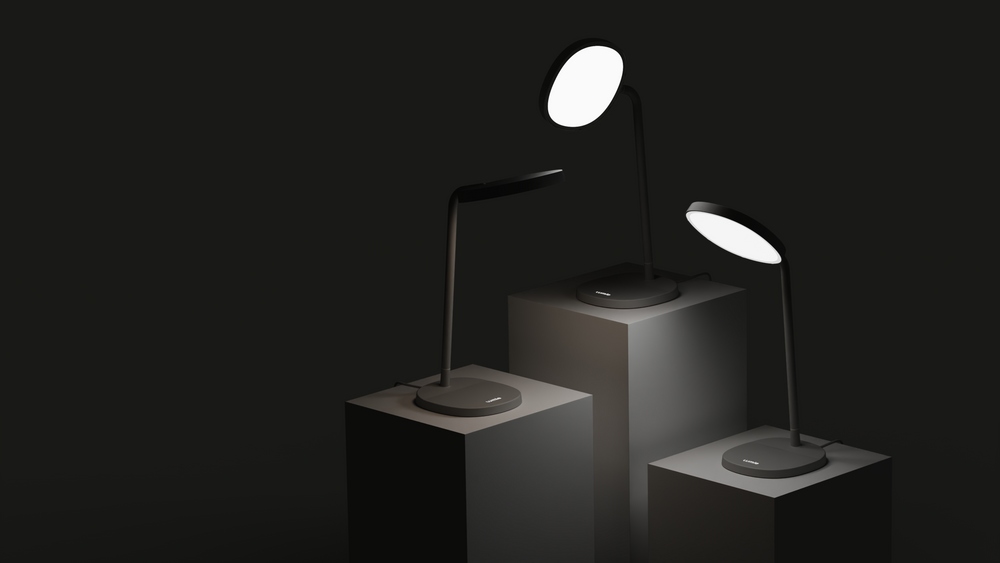
Bringing the sunset indoors with Willow
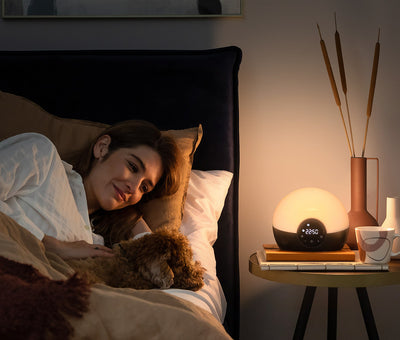
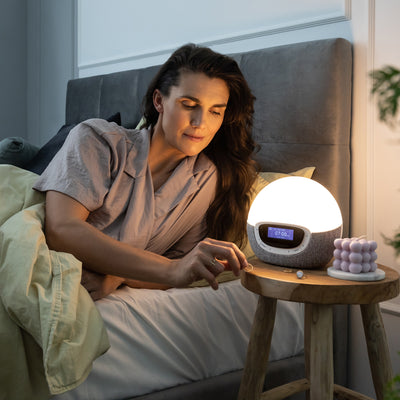
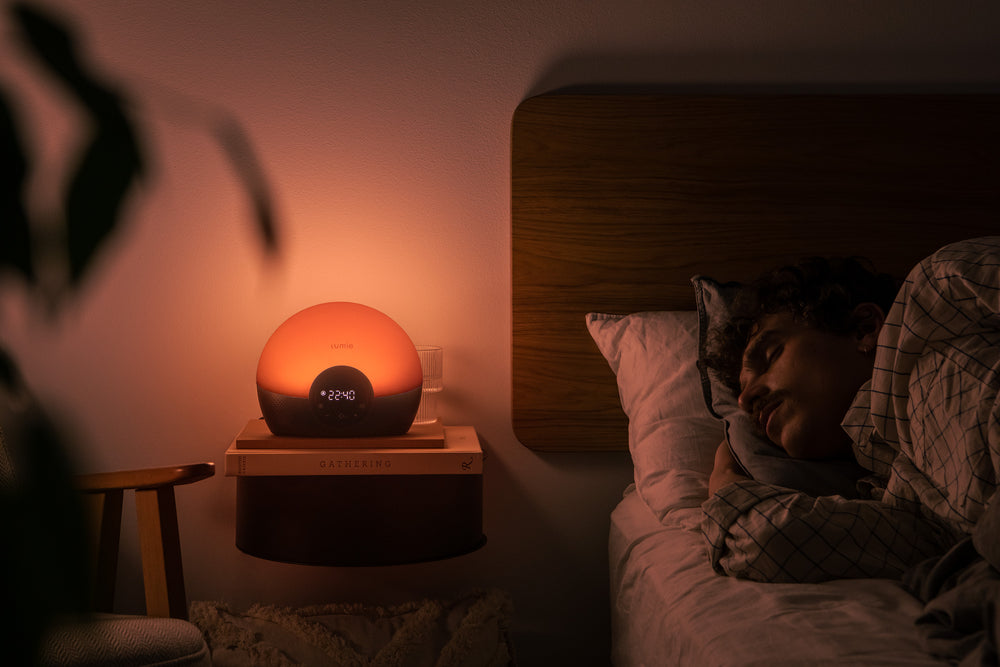
Willow was created to make these principles beautifully simple to use. It begins as a warm, fully adjustable bedside light, providing the illumination families genuinely need for changing, feeding, reading, talking and getting ready for bed. Then, at the touch of one button, Willow begins its 20-minute sunset. The light gradually fades from warm white through orange and red, ending either in darkness or at an optional, gentle nightlight.
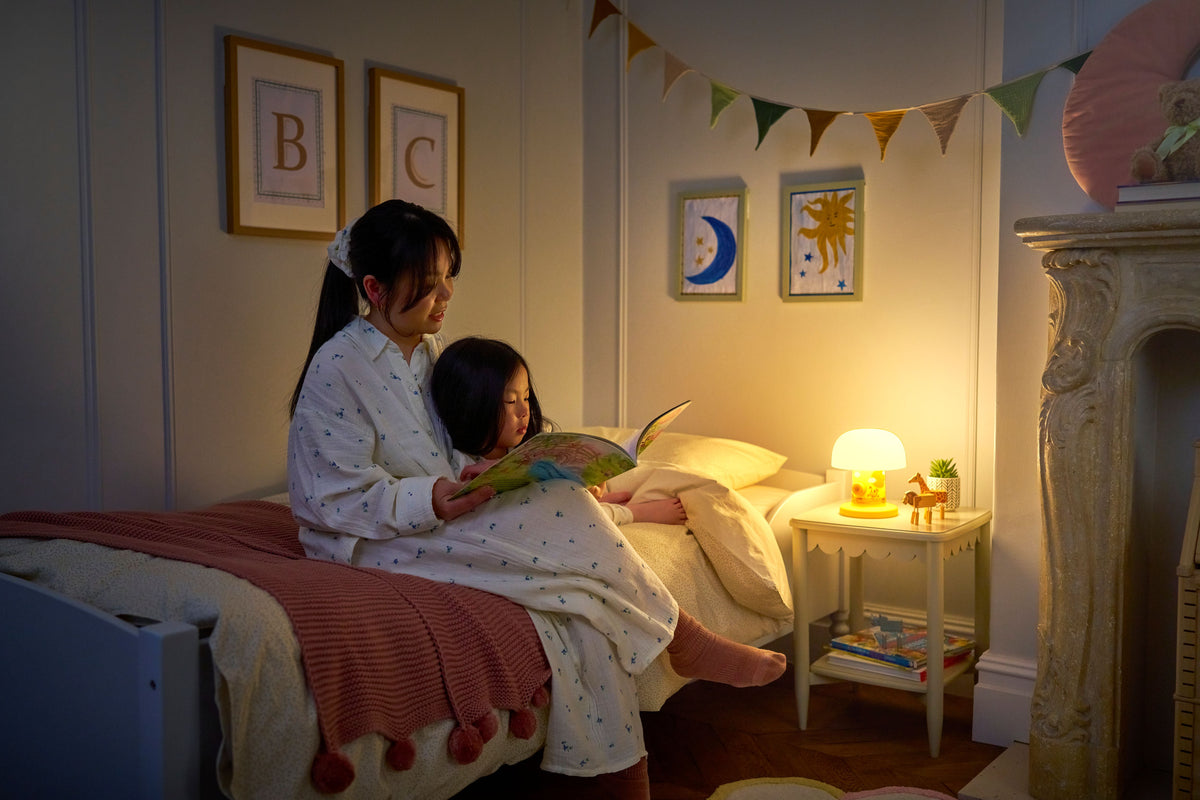
Instead of keeping the bedroom brightly lit until the final moment, the room changes alongside the routine. As stories are read, bottles are finished and cuddles become quieter, the light continues its gradual journey towards night.
Over time, this creates more than a beautiful atmosphere. The fading light can become a recognisable part of bedtime: a simple, repeatable cue that the day is drawing to a close.
The optional nightlight offers a warm, low-level glow for a little illumination or reassurance overnight. Silent controls allow parents to adjust the brightness during feeds and checks without adding sound, opening an app or suddenly flooding the room with bright light.
You are already doing the part that matters: creating closeness, comfort and repetition. Willow doesn’t create the ritual; you do. It simply illuminates it, softening and gradually dimming as another busy day of parenting draws to a close. Night after night, those small, repeated moments become a language your child comes to know - one that gently says: the day is done, and it’s time to rest.
References
-
Hartstein LE et al. High sensitivity of melatonin suppression response to evening light in preschool-aged children. Journal of Pineal Research. 2022;72:e12780. PubMed
-
Akacem LD, Wright KP Jr, LeBourgeois MK. Sensitivity of the circadian system to evening bright light in preschool-age children. Physiological Reports. 2018;6:e13617. PubMed
-
Akacem LD, Wright KP Jr, LeBourgeois MK. Bedtime and evening light exposure influence circadian timing in preschool-age children: a field study. Neurobiology of Sleep and Circadian Rhythms. 2016;1:27–31. PubMed
-
Hartstein LE et al. The circadian response to evening light spectra in early childhood: preliminary insights. 2025. PubMed
-
Glickman G et al. Quantifying the biological impacts of nightlights: implications for sleep and circadian health in children. 2026. PubMed